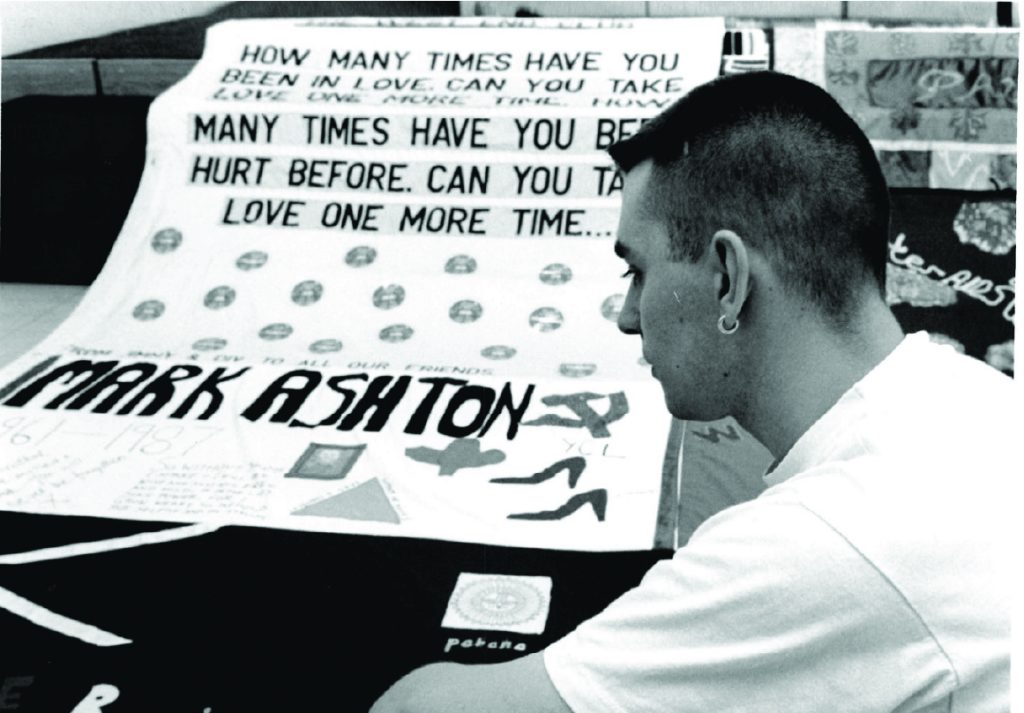
We are looking for up to 10 people with confident hand and machine sewing skills to help care for the UK AIDS Memorial Quilt, which remembers over 600 people lost to HIV and AIDS in the UK.
How to apply:
complete the online form by 21 December 2026.
Please read the full role description below and check you can meet all of these before you apply:
- You can volunteer in person at Positive East in east London
- You can commit to 1 or 2 sessions a month, on weekdays between 10am and 4pm, for at least 12 months
- You are confident sewing by hand and by machine
The programme runs until 2029, and we hope many volunteers will want to stay involved for longer.
If any of these don’t fit right now, this role may not be the right one for you. You can sign up to our newsletter at the bottom of this page, where we share all our volunteer opportunities, especially around Quilt displays.
Shortlisted applicants will be invited to an informal chat in early to mid-January. It is a relaxed conversation where we tell you more about the role, answer your questions, and get to know you a little.
Training will start in late January or February 2027.
About the role
The UK AIDS Memorial Quilt remembers over 600 people lost to HIV and AIDS in the UK. Every panel was made by someone who loved the person it remembers. The UK AIDS Memorial Quilt Partnership is building a small team of volunteers to look after these panels, so they stay safe, strong enough to continue to be on display, and the names on them are always remembered.
You will be trained by an expert conservator. You will start by learning how to check and record the condition of panels, then move on to repairs, such as dry surface cleaning, securing loose seams and stitching, and replacing old borders with hanging sleeves so panels can be hung safely. You will also help get panels ready for displays and check them when they come back.
You will be part of a friendly, supportive group that meets regularly to care for one of the most important memorials of the AIDS crisis in the UK, and part of the world’s largest community art project.
Meet Emma, our Quilt conservator

Emma Duggan is a conservator by training. Over the past 25 years she has cared for collections in national museums, local authority museums, arts organisations, healthcare charities and independent collections, and now works across conservation, collection care and exhibitions.
She says: “No two collections are the same, so I like to work collaboratively and find practical, creative solutions that fit each one. I really enjoy working with and learning from volunteers, and I’d love to work with you to care for this unique collection.”
What you will do
- After training, you will check the condition of panels and record what you find, using written forms and photographs in line with museum best practice, and log these on the digital collection management system
- Get panels ready for displays, and check them before they go out on loan and when they come back, against the condition record to check for any changes in appearance
- Fold, pack and label panels safely for storage and travel to our borrowing venues
- Once trained, carry out reversible repairs, such as securing loose seams, dry surface cleaning, and replacing old borders with hanging sleeves
- Flag anything you are unsure about to the UK AIDS Quilt team
- Follow the Quilt’s conservation principles and handling procedures at all times, which are explained in full during training
Who the role suits
No conservation experience is needed, as full training is provided. The role suits people who have:
- Confident hand and machine sewing skills. You are comfortable handling fabric and can sew small, neat, even stitches by hand. Experience of quilting, embroidery, dressmaking or textile repair is a plus.
- Patience and care. You are happy to work slowly and carefully on delicate, irreplaceable panels, and to follow set procedures.
- An eye for detail. You notice small changes and can record them clearly and accurately.
- Openness to learning about the Quilt and HIV. You may have lived experience of HIV, personally or through friends or family, or a connection to LGBTQ+ communities. If not, you have a genuine willingness to learn.
- Respect and sensitivity. You understand the panels are memorials to real people. You use respectful, up-to-date language around HIV and LGBTQ+ communities, and are happy to keep learning.
- Discretion. You keep personal information about the people remembered, their families and makers confidential.
- Reliability. You give notice in good time if you cannot make a session.
- Teamwork. You work well with others and share tasks as part of a group.
Training and support
- Induction and training. Two training days covering the Quilt’s history, HIV today, respectful language, conservation principles and safe handling, and condition checking and recording.
- Condition recording. Supported sessions recording the condition of the collection.
- Repair training. Hands-on training in conservation repairs.
- Ongoing support. Every session is supervised by the UK AIDS Quilt team. Working with memorials can be emotional, and you can always take a break or talk to someone.
When you join, you will receive a volunteer handbook. This includes our Volunteering with care principles, which set out how we look after each other, the people the Quilt remembers and visitors.
What you will get
- Training in textile conservation from an expert conservator
- Hands-on experience caring for a nationally significant heritage collection
- The chance to help keep the Quilt safe and seen for future generations, and make sure the names on it are always remembered
- A friendly, social community of people who share a love of textiles and care about the Quilt
- Expenses for each session: local London travel up to £8.10 (the cost of a TfL day travelcard) and lunch up to £8
- Recognition of your contribution to the Quilt partnership, including travel expenses to attend one Quilt display a year, and an invitation to the annual volunteer celebration in London
How to apply
Complete the online form by 21 December 2026. Shortlisted applicants will be invited to an informal chat in early to mid-January.